
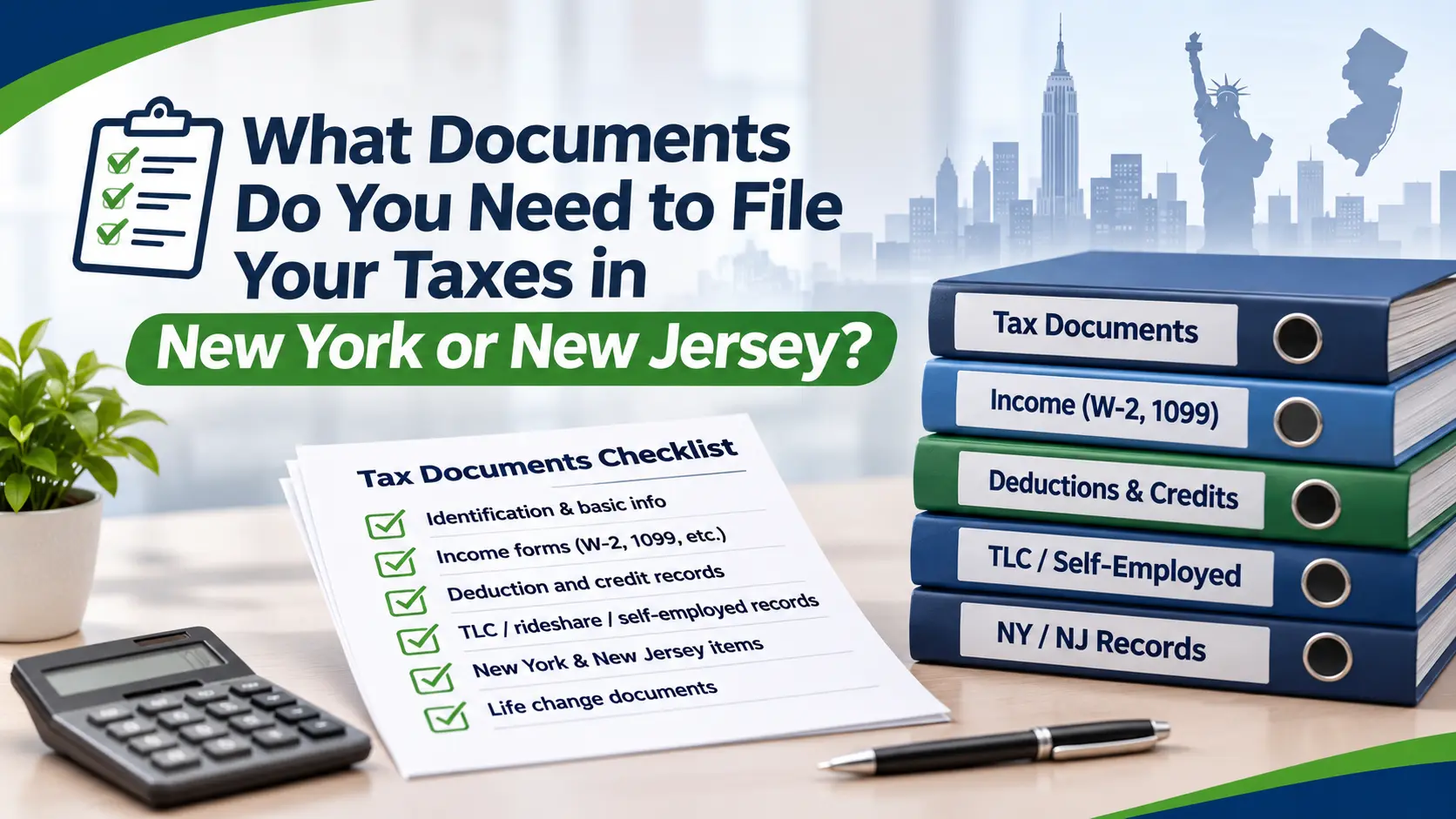
Missing paperwork is a common reason tax returns get delayed, rejected, or amended. Gathering everything first saves time and helps you avoid missing deductions or credits you may qualify for.
What Documents Do You Need to File Your Taxes in New York or New Jersey?
Tax season goes more smoothly when you start organised. Missing paperwork is a common reason returns get delayed or amended, and gathering everything up front helps you avoid missing deductions or credits you may qualify for.
Whether you file on your own or use tax preparation in NYC or tax filing services in NJ, here’s what to collect.
This checklist is for your tax year 2026 return—covering income earned from January 1 through December 31, 2026—which you’ll file in early 2027. Not every item applies to everyone.
The Basics
Start with what identifies you and your household:
Social Security numbers (or ITINs) and dates of birth for everyone on the return
Last year’s federal and state tax returns
Your IRS Identity Protection PIN, if applicable
Bank account and routing numbers for direct deposit, since the IRS has been phasing out paper refund checks
The date of any marriage or divorce during the year
Any IRS or state notices, identity-verification letters, balance-due notices, or other tax correspondence
Income Documents
Income documents are the core of your tax return. Even if you didn’t receive a tax form for certain income, you may still need to report it.
Form W-2 from every employer
Forms 1099-NEC, 1099-K, or 1099-MISC for freelance, gig, or rideshare income
Forms 1099-INT, 1099-DIV, and 1099-B for interest, dividends, and investment sales
Form 1099-DA for crypto or other digital assets sold through a broker. Keep your own purchase, sale, and transfer records, since complete cost-basis information may not appear on the form.
Forms 1099-R and SSA-1099 for retirement and Social Security income
Form 1099-G for unemployment benefits or state tax refunds
Schedule K-1 from any partnership, S corporation, or trust
Documents for New Federal Deductions
Recent federal tax law created new deductions, each with its own eligibility rules and income limits. Bring these records if they may apply:
Tips or overtime: a W-2 or other statement showing qualified tips or qualified overtime pay
Car loan interest: your lender’s interest statement and the vehicle’s VIN. This generally applies only to qualifying new, personal-use vehicles assembled in the U.S. TLC and other business vehicles may follow different rules, so not every driver will qualify.
Charitable donations: beginning with tax year 2026, taxpayers who take the standard deduction may be able to deduct qualifying cash donations to eligible charities, up to $1,000 (double that for married couples filing jointly), according to the IRS. Keep receipts.
State rules may differ. Federal deductions for qualified tips and overtime do not necessarily receive the same treatment on New York or New Jersey returns, so ask your preparer how they apply to you.
Deduction and Credit Records
These records may help lower your tax bill, depending on your situation:
Form 1098 for mortgage interest, property tax bills, or rent records, which may matter for state relief programs
Child care provider details and amounts paid
Form 1098-T for tuition and Form 1098-E for student loan interest
Form 1095-A if you had marketplace health insurance
Retirement account and HSA contribution records
Estimated tax payment records
For TLC Drivers, Rideshare Drivers, and the Self-Employed
Self-employed workers and TLC drivers typically need more records than W-2 employees, because business income and expenses must be documented separately. If you drive for Uber, Lyft, or a TLC base, or run a business, bring:
All 1099s, plus each app’s annual tax summary
Records of income that may not appear on a 1099, such as cash payments, direct client payments, or payment-app transfers
Your mileage log, plus toll and parking records
TLC license, renewal, inspection, and drug test receipts
Vehicle insurance, lease or rental, loan, and repair records
Phone, equipment, and other business expense receipts
Bring all vehicle-related records, even if you’re unsure what’s deductible. Your preparer can help determine whether the standard mileage or actual-expense method is more appropriate for you.
New York and New Jersey Items
Living or working in the New York area adds a few items:
Moving dates, if you moved into or out of NYC, New York State, or New Jersey
W-2s showing withholding for each state, if you live in one state and work in the other
Health coverage forms (1095-A, 1095-B, or 1095-C), if applicable. New Jersey has its own health coverage requirement, and these forms help show coverage.
State 529 plan contribution records. Contributions may be deductible on your state return, depending on the plan and eligibility rules.
Life Changes That Need Extra Paperwork
Major life events often mean extra documents:
Married or divorced: your marriage certificate or divorce decree
New child: the child’s Social Security card
Bought or sold a home: your closing statement
Lost a job: Form 1099-G
Retired: Forms 1099-R and SSA-1099
Don’t File Too Early
Most W-2s and 1099s arrive by the end of January, but brokerage forms often come in February and K-1s in March or later. Filing before you have everything often leads to an amended return.
How Freedom Line Brokerage Can Help
If you’ve been searching for a “tax preparer near me,” Freedom Line Brokerage offers tax and accounting services for individuals, TLC drivers, and small business owners across New York and New Jersey. We can help you:
Build a document checklist based on your situation
Spot missing forms before you file
Check whether you may qualify for new federal deductions
Prepare and file your federal, New York, and New Jersey returns
Bring what you have—we’ll help find what’s missing.
The Bottom Line
Organized documents are the foundation of an accurate return. Start with the basics, then work through each section above. When you’re ready, contact Freedom Line Brokerage for tax preparation in NYC or tax filing services in NJ.
Freedom Line Brokerage
75-25 31st Avenue, East Elmhurst, NY 11370 · (718) 937-6180 · freedomlinebrokerage.com
This article is for general informational purposes only and is not tax, legal, or financial advice. Consult a qualified tax professional about your situation.