
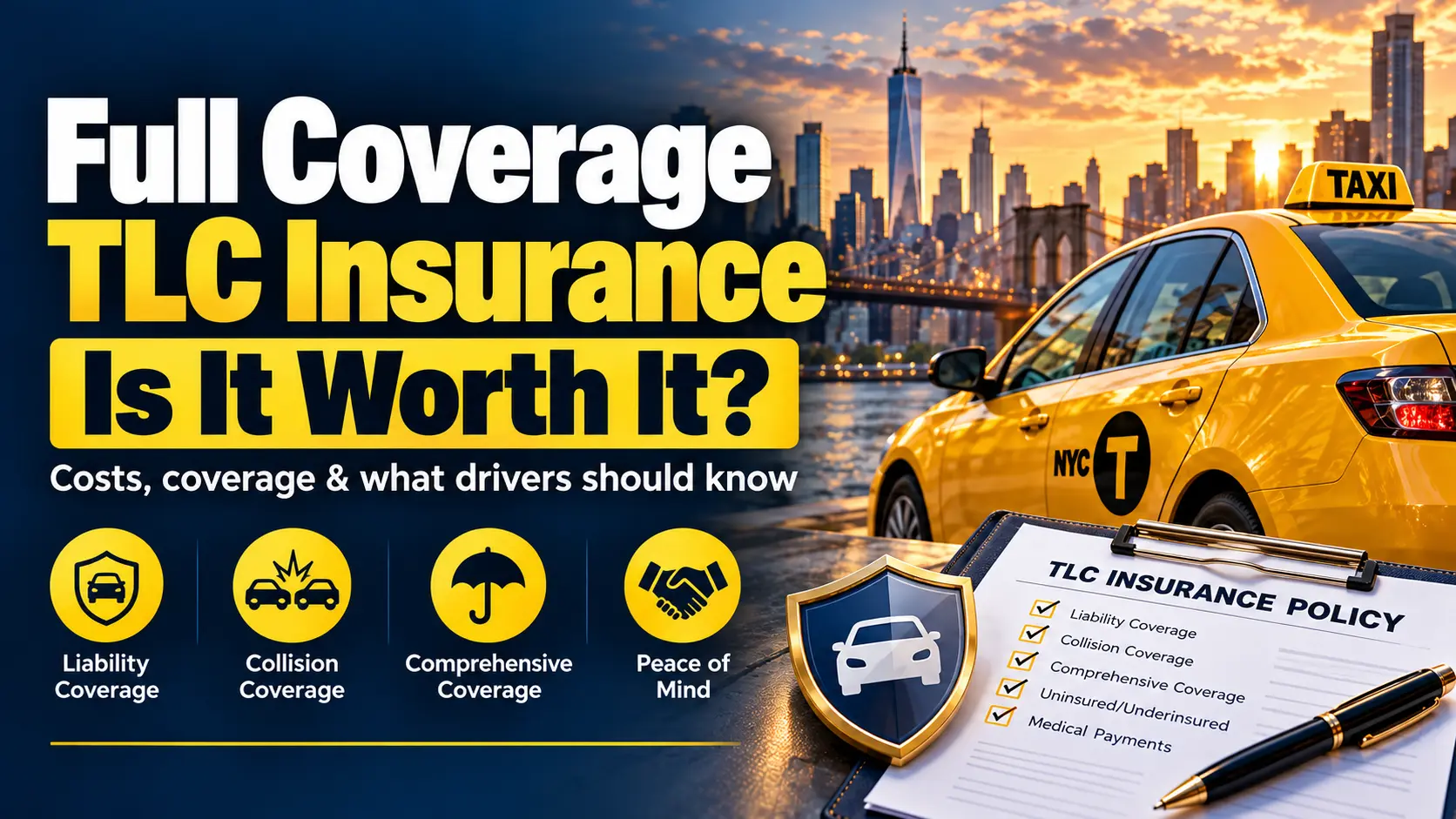
If you operate a TLC-licensed vehicle in New York City, insurance is one of the most important operating costs to understand. But simply knowing that you need TLC-compliant insurance isn't enough. You also need to understand what your policy covers—and, just as importantly, what it does not cover.
One of the most common questions TLC vehicle owners ask is whether they should carry liability coverage only or broader coverage that includes collision and comprehensive insurance. The answer depends on several factors, including your vehicle's value, whether it is financed or leased, your ability to absorb a major loss, and the coverage options available for your particular vehicle. This guide explains the difference so you can make a more informed decision.
What Is TLC Insurance?
TLC insurance refers to insurance coverage for vehicles licensed by the New York City Taxi and Limousine Commission (TLC). TLC-licensed vehicles must maintain insurance that meets the applicable minimum requirements for their vehicle type and seating capacity.
For example, current TLC requirements for many 1–7 passenger For-Hire Vehicles (FHVs), including livery vehicles and black cars, include:
$100,000 per person for bodily injury
$300,000 per occurrence for bodily injury
$10,000 property damage
$100,000 Personal Injury Protection (PIP)
The requirements are different for other vehicle categories and passenger capacities. Luxury limousines, medallion taxis, commuter vans, and larger passenger vehicles can have different insurance requirements.
TLC-licensed vehicles must maintain proof of current liability insurance, including the applicable FH-1 insurance certificate, on file with the TLC. An expired or insufficient policy can prevent a vehicle license from being renewed.
TLC Insurance Is Different From Personal Auto Insurance
A personal auto policy is generally not designed for commercial for-hire passenger transportation. Using a personal vehicle for paid passenger transportation when the policy does not provide the required coverage can create significant coverage problems.
The appropriate insurance depends on how the vehicle is licensed and used. A TLC vehicle needs coverage that satisfies the applicable TLC and New York requirements.
What Does TLC Liability Insurance Cover?
Liability coverage is primarily designed to protect against claims arising from injuries to other people or damage to other people's property for which the insured is legally responsible, subject to the policy's limits and terms.
Depending on the policy, this can include liability arising from an accident involving:
Passengers
Pedestrians
Occupants of another vehicle
Another person's vehicle or property
However, liability coverage generally does not pay for physical damage to your own vehicle simply because you caused an accident.
Example
Suppose a TLC driver is involved in an accident and is determined to be responsible.
The liability portion of the policy may respond to covered claims for injuries to other people and damage to their property, subject to the policy's limits.
If the driver's own vehicle is also damaged, however, liability coverage generally does not pay for repairing that vehicle.
That is where collision coverage may become important.
What Does "Full Coverage" TLC Insurance Mean?
"Full coverage" is not a formal insurance policy term. It is commonly used to describe a policy that combines liability insurance with coverage such as collision and comprehensive.
The exact coverages included should always be confirmed with the insurer or broker because policies can differ.
Collision Coverage
Collision coverage generally applies to covered physical damage to your vehicle resulting from a collision, subject to the policy's deductible, exclusions, and conditions.
For example, it may apply when your vehicle is damaged after colliding with:
Another vehicle
A stationary object
A guardrail
A pole
Another object
The amount paid is subject to the policy's terms, including the deductible and applicable valuation provisions.
Comprehensive Coverage
Comprehensive coverage generally applies to covered physical damage caused by events other than collision.
Depending on the policy, examples can include:
Theft
Vandalism
Fire
Hail
Flood or certain other water-related events
Falling objects
Damage caused by animals
Glass coverage may also be handled under comprehensive coverage depending on the circumstances and policy terms.
Together, collision and comprehensive coverage can provide protection for the physical vehicle that liability coverage does not provide.
Liability vs. Broader Coverage for TLC Vehicles
Coverage / Situation | Liability Coverage | Collision + Comprehensive |
|---|---|---|
Injury to another person for which you are legally responsible | May be covered | May be covered |
Damage to another person's property for which you are legally responsible | May be covered | May be covered |
Damage to your vehicle from a covered collision | Generally not covered | May be covered under collision |
Theft of your vehicle | Generally not covered | May be covered under comprehensive |
Vandalism | Generally not covered | May be covered under comprehensive |
Certain weather-related damage | Generally not covered | May be covered under comprehensive |
Deductible for damage to your vehicle | Not applicable to liability claim in the same way | Usually applies to collision/comprehensive claims |
Premium | Generally lower | Generally higher |
Coverage depends on the specific policy. Limits, deductibles, exclusions, valuation methods, and endorsements can all affect how a claim is handled.
Is Full Coverage TLC Insurance Worth It?
There is no single answer for every TLC vehicle owner.
Broader physical-damage coverage may be worth considering when the financial consequences of losing or repairing the vehicle would be difficult for you to absorb.
Your Vehicle Has Significant Value
If your TLC vehicle is relatively new or has a high market value, you may have substantially more money at risk if the vehicle is damaged or stolen.
With liability-only coverage, damage to your own vehicle is generally your responsibility.
Your Vehicle Is Financed or Leased
If your vehicle is financed or leased, check your agreement carefully.
A lender or leasing company may require physical-damage coverage such as comprehensive and collision. The required deductible may also be specified by the financing agreement.
Therefore, the insurance requirements in your loan or lease agreement should be reviewed before selecting a policy.
Your Vehicle Is Essential to Your Income
For many TLC vehicle owners, the vehicle is also a business asset.
If your vehicle is damaged, stolen, or declared a total loss, the financial impact may extend beyond the vehicle itself.
However, collision and comprehensive coverage do not automatically reimburse lost income simply because your vehicle is unavailable. Whether a policy provides rental reimbursement, transportation expenses, loss-of-use coverage, or another form of assistance depends on the specific policy and endorsements.
Ask your broker or insurer what options are actually available for your vehicle.
You Could Not Easily Replace the Vehicle
Consider a simple question:
If your vehicle were severely damaged or stolen tomorrow, could you afford to repair or replace it without creating a major financial problem?
If the answer is no, physical-damage coverage may deserve closer consideration.
When Might Liability-Only Coverage Make Sense?
TLC's minimum insurance requirements focus on required liability and related coverage. Collision and comprehensive coverage are separate physical-damage protections and should not be confused with the TLC-required minimum liability coverage.
Some vehicle owners may consider carrying only the required coverage when:
The vehicle has relatively low market value.
The cost of additional physical-damage coverage is significant compared with the vehicle's value.
The owner has sufficient savings to handle a major repair or replacement.
The owner understands and accepts the financial risk of damage to the vehicle.
The vehicle's financing or lease agreement does not require physical-damage coverage.
This decision should be based on the actual premium, deductible, vehicle value, financing requirements, and coverage available for the particular vehicle.
Why Vehicle Repair Costs Matter
Modern vehicles can be considerably more complicated to repair than older vehicles.
A collision that appears minor from the outside can involve:
Cameras
Parking sensors
Radar systems
Advanced driver-assistance systems (ADAS)
LED lighting assemblies
Electronic components
Specialized calibration
High-strength materials and other modern body components
Depending on the vehicle, repairs may require both replacement parts and specialized calibration.
For a TLC vehicle that is driven frequently in New York City traffic, understanding the potential cost of physical damage is particularly important when deciding whether to assume that risk yourself.
What About Total Loss?
One important point that is sometimes misunderstood is that full coverage does not necessarily mean you receive enough money to purchase a brand-new replacement vehicle.
If an insured vehicle is declared a total loss, the insurer generally determines the applicable settlement according to the policy's valuation provisions and applicable law, subject to the policy terms and deductible where applicable.
The vehicle's age, condition, market value, and other factors can therefore affect the claim settlement.
If your vehicle has a loan balance greater than its insurance settlement, you should also understand whether you have any separate gap protection.
What About a Deductible?
Collision and comprehensive coverage commonly involve deductibles.
For example, if a covered collision causes $8,000 in damage and your applicable collision deductible is $1,000, the policy may pay the covered amount above the deductible, subject to the policy's terms.
A higher deductible can sometimes reduce the premium, while a lower deductible generally means you pay less out of pocket when a covered claim occurs.
The right deductible depends on what you can realistically afford after an accident.
How Freedom Line Brokerage Can Help
Freedom Line Brokerage can help TLC vehicle owners understand the coverage options available for their particular situation.
When reviewing your insurance, you can discuss:
The TLC insurance requirements applicable to your vehicle
Liability limits
PIP requirements
Collision and comprehensive options
Deductibles
Vehicle value
Financing or leasing requirements
Available coverage options
Exclusions and policy conditions
Additional coverage options that may be available
A broker can also help you compare available insurance options rather than looking only at the premium.
The goal is not simply to purchase the most coverage or the least expensive policy. It is to understand what you are paying for, what risks you are retaining, and whether the policy meets your needs and applicable requirements.
Questions to Ask Before Choosing TLC Insurance
Before purchasing or renewing your policy, consider asking:
What TLC insurance requirements apply to my specific vehicle?
What liability limits does my policy provide?
What PIP coverage is included?
Does my policy include collision coverage?
Does it include comprehensive coverage?
What are my collision and comprehensive deductibles?
What exclusions apply?
How is my vehicle valued if it is declared a total loss?
Does my lender or leasing company require specific coverage or a maximum deductible?
Is rental reimbursement or another temporary transportation benefit available?
What happens if the vehicle is stolen?
What happens if the vehicle is damaged but can still be repaired?
These questions can help you understand the difference between simply meeting the minimum insurance requirements and purchasing additional protection for your vehicle.
The Bottom Line on Full Coverage TLC Insurance
TLC-required insurance and physical-damage coverage serve different purposes.
Liability coverage is designed primarily to protect against covered claims involving injuries to others and damage to other people's property for which you are legally responsible.
Collision and comprehensive coverage can provide protection for covered physical damage to your own vehicle.
Whether broader coverage makes sense depends on your vehicle's value, financing or lease requirements, deductible, premium, financial situation, and willingness to assume the risk yourself.
For a newer, financed, leased, or higher-value vehicle, it may be particularly important to understand the financial consequences of going without physical-damage coverage.
If you are unsure what coverage your TLC vehicle needs, review your current policy and discuss the available options with a licensed insurance professional.
Freedom Line Brokerage 75-25 31st Avenue, East Elmhurst, NY 11370 (718) 937-6180 freedomlinebrokerage.com
This article is for general informational purposes only and is not legal or financial advice. TLC insurance requirements can vary by vehicle type and seating capacity, and insurance coverage varies by insurer and policy. Always review your policy documents and confirm current TLC requirements before making an insurance decision.